







I’ve finally reached the moment where I’ve run out of space. Completely. Not a single empty square left on the commercial side of my city. And because I’ve been building this city with a very specific philosophy in mind, I wanted to share the numbers behind it — how I plan, why I place buildings the way I do, and what I’ve learned while trying to design my own “ultimate city.” Maybe some of this will help you shape yours.
Before diving into the buildings themselves, it’s important to understand what I’m actually aiming for. My goals aren’t random — they guide every placement, every replacement, and every painful decision to remove a building I’ve had for years.
My goals look like this:
Ultimate goal: Have every building at least once while still maximizing residential yield per square.
High‑priority goals: Increase maximum population, expand terminal capacity, and maintain the magic square.
Medium‑priority goals: Keep a healthy balance between residential and commercial buildings, maintain enough collectible buildings, and ensure I have enough bonus‑providing buildings.
Not a goal: Electricity consumption or population requirements — except when I’m replacing duplicate buildings, where I do check these attributes.
So far, I’m achieving most of this. But I already know I won’t be able to place every building without removing some residential buildings I own multiple times. That’s simply the reality of trying to fit an entire catalogue into a finite grid.
Understanding the Building Catalogue
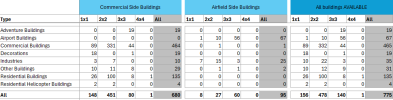
Before talking about my city, it helps to understand the sheer scale of the building catalogue. As of today, the game contains 775 unique buildings. I only count upgradeable buildings once — not every level separately. These buildings fall into eight major categories, most of them defined by the forum (with maybe one or two categories I added myself).
These eight categories cover the entire range of what you can build: Adventure buildings (19); Airport buildings (67); Commercial buildings (465); Decorations (19); Industry buildings (35); Other buildings (31); Residential buildings (135); and Residential Helicopter buildings (4).
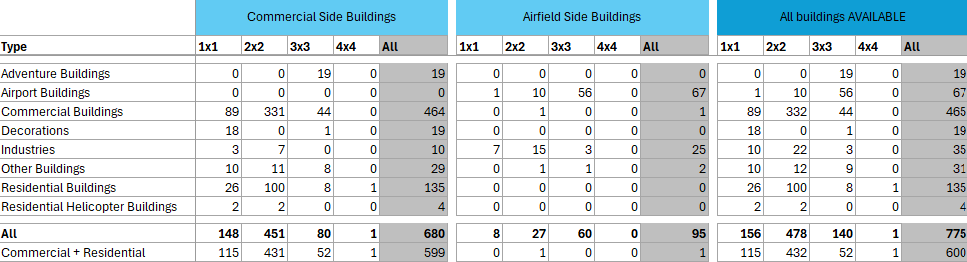
Out of all these buildings, 680 can be placed on the commercial side, while 95 belong to the airfield/ industrial side. Those 95 include every boarding bridge, parking lot, and terminal section counted individually, since each occupies its own physical space. Buildings like the control tower, runway, and other upgradeable airport structures are counted only once.
Of the 680 commercial‑side buildings, 464 are commercial and 135 are residential, making 599 buildings that directly matter for the commercial zone. On the airfield side, only one building is technically commercial — the Training Center — and I build it there specifically so I don’t waste precious commercial space. No residential buildings can be placed on the airfield, and the rest are airport or industrial structures.
If I break down the commercial‑side catalogue even further, I can see that most buildings use a 2×2 grid. In fact, 451 (+1 for Training Center) buildings — about two‑thirds — are 2×2 . Another 148 are 1×1, 80 are 3×3, and only one building in the entire game uses a 4×4 footprint: The Red Queen’s Castle.
The Space I’m Working With
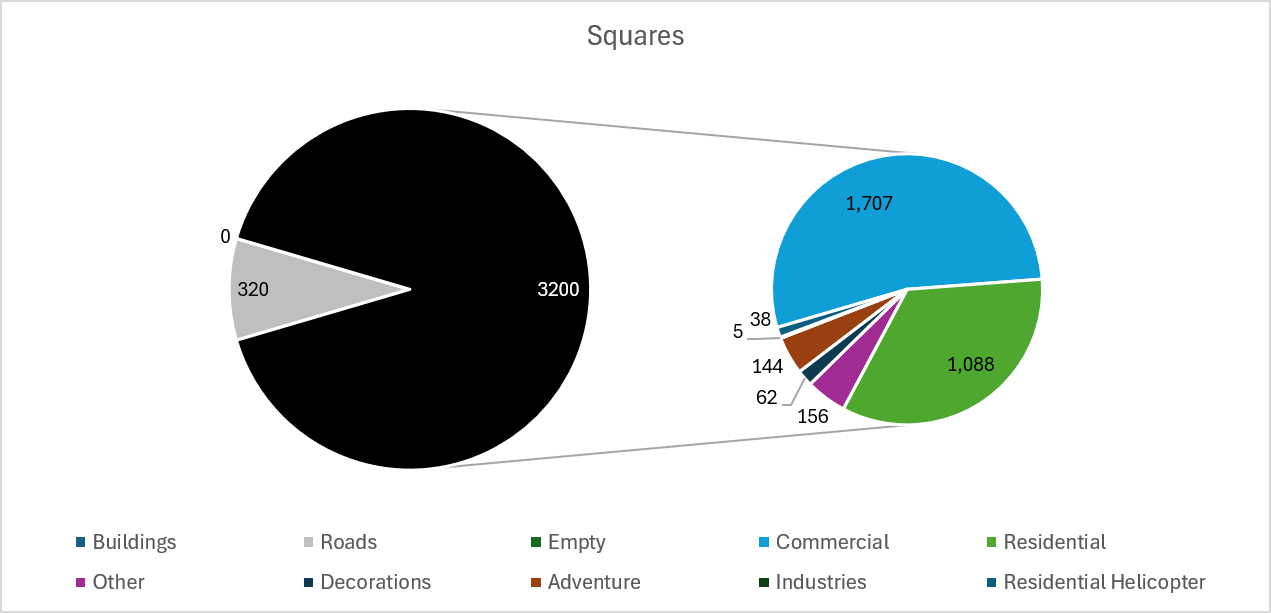
The commercial side of the airport city has a maximum size of 3,520 squares — that’s 11 tiles wide, 20 tiles long, and 16 squares per tile. Out of those 3,520 squares, I currently have 3200 filled with buildings and 320 squares of roads, leaving zero empty squares. I could probably squeeze in a few more buildings that don’t require road access, but for all practical purposes, the zone is full.
Out of the 3200 building squares in my commercial zone, 1707 are taken by Commercial buildings; 0 by airport buildings; 1088 by Residential buildings; 156 by Other buildings; 62 by Decorations buildings; 144 by Adventure buildings; 5 by Industries buildings and 38 by Residential Helicopter buildings.
This means 53.34% of my commercial zone is commercial buildings, 34.00% is residential, and 12.66% is everything else. Ideally, I’d like to increase the residential share slightly, but doing so would require removing commercial buildings — something I’m not quite ready to do just yet. I’m also hoping that one day we’ll be able to unlock or purchase more tiles on the commercial side, because I’m definitely at the limit.
What I Actually Own
Now for the buildings themselves — again, focusing only on the commercial side, since the airfield is easy to fill as long as you have coins.
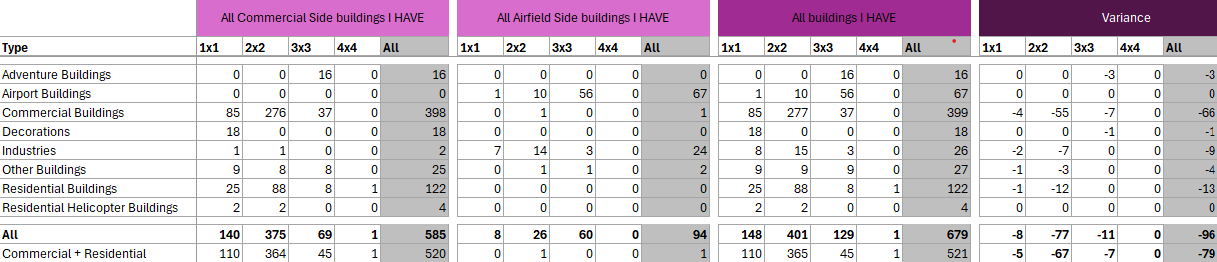
Out of the 680 buildings that can be placed on the commercial side, I own 585, which is 86.03%. When I look specifically at commercial and residential buildings, I own 520 out of 599, which is almost the same percentage — 86.81%. Breaking that down further, I have 398 out of 464 commercial buildings and 122 out of 135 residential buildings.
That means I’m missing 79 commercial and residential buildings. When I add all other categories, the total number of buildings missing from my city rises to 96.
How My City Performs
Inside the commercial zone, I have 987 buildings occupying 3200 squares, which means the average building in my city is 3.24 squares in size.

These buildings give me:
9559 maximum population
5261 population used
6696 electricity consumption
Which works out to:
9.68 population per building
2.99 population per square
5.33 population used per building
1.64 population used per square
6.78 electricity per building
2.09 electricity per square
If I split the city into commercial and residential buildings, the numbers shift slightly. My commercial buildings — 498 of them — occupy 1707 squares, averaging 3.43 squares per building. My residential buildings — 339 of them — occupy 1088 squares, averaging 3.21 squares per building.
Electricity consumption is almost identical between the two categories: commercial buildings use 2.30 electricity per square, residential buildings use 2.31.
Population, however, is where the two categories differ dramatically. My commercial buildings provide 3.15 maximum population per square, while residential buildings provide only 1.36. But when it comes to population used, the situation flips: commercial buildings use 1.37 population per square, while residential buildings use 2.68.
This tells me exactly what I suspected — I’m using a lot of residential buildings that consume population rather than provide it, especially store‑type residentials. I’ll get into those later, but for now it’s enough to say that maximizing residential yield per square is a lot harder than it looks, simply because so many residential buildings exist for bonuses or collections rather than population.
Before diving into the buildings themselves, it’s important to understand what I’m actually aiming for. My goals aren’t random — they guide every placement, every replacement, and every painful decision to remove a building I’ve had for years.
My goals look like this:
Ultimate goal: Have every building at least once while still maximizing residential yield per square.
High‑priority goals: Increase maximum population, expand terminal capacity, and maintain the magic square.
Medium‑priority goals: Keep a healthy balance between residential and commercial buildings, maintain enough collectible buildings, and ensure I have enough bonus‑providing buildings.
Not a goal: Electricity consumption or population requirements — except when I’m replacing duplicate buildings, where I do check these attributes.
So far, I’m achieving most of this. But I already know I won’t be able to place every building without removing some residential buildings I own multiple times. That’s simply the reality of trying to fit an entire catalogue into a finite grid.
Understanding the Building Catalogue
Before talking about my city, it helps to understand the sheer scale of the building catalogue. As of today, the game contains 775 unique buildings. I only count upgradeable buildings once — not every level separately. These buildings fall into eight major categories, most of them defined by the forum (with maybe one or two categories I added myself).
These eight categories cover the entire range of what you can build: Adventure buildings (19); Airport buildings (67); Commercial buildings (465); Decorations (19); Industry buildings (35); Other buildings (31); Residential buildings (135); and Residential Helicopter buildings (4).
Out of all these buildings, 680 can be placed on the commercial side, while 95 belong to the airfield/ industrial side. Those 95 include every boarding bridge, parking lot, and terminal section counted individually, since each occupies its own physical space. Buildings like the control tower, runway, and other upgradeable airport structures are counted only once.
Of the 680 commercial‑side buildings, 464 are commercial and 135 are residential, making 599 buildings that directly matter for the commercial zone. On the airfield side, only one building is technically commercial — the Training Center — and I build it there specifically so I don’t waste precious commercial space. No residential buildings can be placed on the airfield, and the rest are airport or industrial structures.
If I break down the commercial‑side catalogue even further, I can see that most buildings use a 2×2 grid. In fact, 451 (+1 for Training Center) buildings — about two‑thirds — are 2×2 . Another 148 are 1×1, 80 are 3×3, and only one building in the entire game uses a 4×4 footprint: The Red Queen’s Castle.
The Space I’m Working With
The commercial side of the airport city has a maximum size of 3,520 squares — that’s 11 tiles wide, 20 tiles long, and 16 squares per tile. Out of those 3,520 squares, I currently have 3200 filled with buildings and 320 squares of roads, leaving zero empty squares. I could probably squeeze in a few more buildings that don’t require road access, but for all practical purposes, the zone is full.
Out of the 3200 building squares in my commercial zone, 1707 are taken by Commercial buildings; 0 by airport buildings; 1088 by Residential buildings; 156 by Other buildings; 62 by Decorations buildings; 144 by Adventure buildings; 5 by Industries buildings and 38 by Residential Helicopter buildings.
This means 53.34% of my commercial zone is commercial buildings, 34.00% is residential, and 12.66% is everything else. Ideally, I’d like to increase the residential share slightly, but doing so would require removing commercial buildings — something I’m not quite ready to do just yet. I’m also hoping that one day we’ll be able to unlock or purchase more tiles on the commercial side, because I’m definitely at the limit.
What I Actually Own
Now for the buildings themselves — again, focusing only on the commercial side, since the airfield is easy to fill as long as you have coins.
Out of the 680 buildings that can be placed on the commercial side, I own 585, which is 86.03%. When I look specifically at commercial and residential buildings, I own 520 out of 599, which is almost the same percentage — 86.81%. Breaking that down further, I have 398 out of 464 commercial buildings and 122 out of 135 residential buildings.
That means I’m missing 79 commercial and residential buildings. When I add all other categories, the total number of buildings missing from my city rises to 96.
How My City Performs
Inside the commercial zone, I have 987 buildings occupying 3200 squares, which means the average building in my city is 3.24 squares in size.
These buildings give me:
9559 maximum population
5261 population used
6696 electricity consumption
Which works out to:
9.68 population per building
2.99 population per square
5.33 population used per building
1.64 population used per square
6.78 electricity per building
2.09 electricity per square
If I split the city into commercial and residential buildings, the numbers shift slightly. My commercial buildings — 498 of them — occupy 1707 squares, averaging 3.43 squares per building. My residential buildings — 339 of them — occupy 1088 squares, averaging 3.21 squares per building.
Electricity consumption is almost identical between the two categories: commercial buildings use 2.30 electricity per square, residential buildings use 2.31.
Population, however, is where the two categories differ dramatically. My commercial buildings provide 3.15 maximum population per square, while residential buildings provide only 1.36. But when it comes to population used, the situation flips: commercial buildings use 1.37 population per square, while residential buildings use 2.68.
This tells me exactly what I suspected — I’m using a lot of residential buildings that consume population rather than provide it, especially store‑type residentials. I’ll get into those later, but for now it’s enough to say that maximizing residential yield per square is a lot harder than it looks, simply because so many residential buildings exist for bonuses or collections rather than population.

 Nayeon


